How to qualify international buyers before committing resources
An enquiry is a reason to investigate, not a reason to extend credit or reserve production. Buyer qualification helps a small export team decide where to spend time and what to verify before moving further. It also keeps a confident conversation from being mistaken for a confirmed opportunity.

Start with commercial fit
Describe the buyer you are looking for in operational terms: industry, application, purchasing channel and product requirements. Then ask whether the company actually serves that use case. A large business outside your target channel may be less relevant than a smaller specialist with a clear requirement.
For each contact, retain the original source and the reason for inclusion. A trade-fair directory, an industry association and a referral can all generate leads. None, on its own, establishes financial reliability or suitability for a particular transaction.
Understand who is speaking and who decides
Ask how new suppliers are assessed. Who checks the specification? Who negotiates terms? Who issues the purchase order? Try to understand the process without making the contact feel interrogated. A helpful technical discussion is progress even when it does not immediately become a sale.
Record the answer in plain language. “Interested” is too vague to guide the team. “Technical manager requested a sample specification; procurement review follows acceptance” gives the next person something usable. If no next step has been agreed, say so.
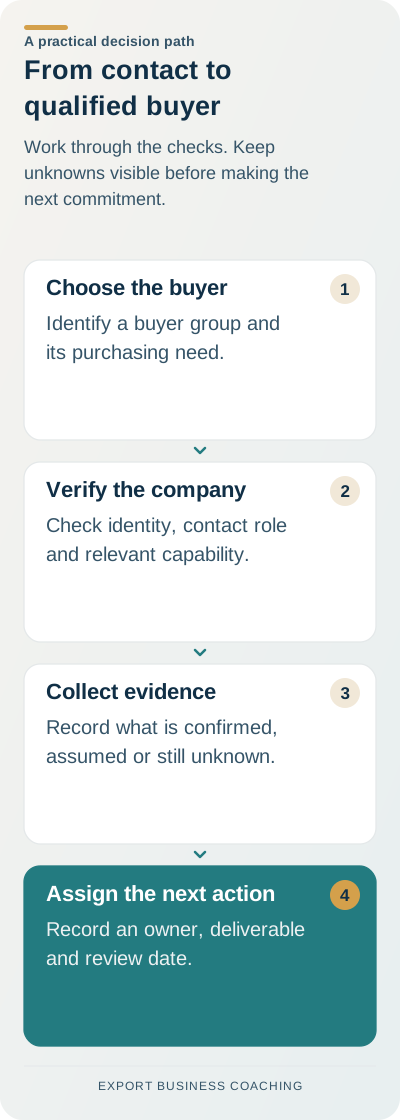
From contact to qualified buyer
Work through the checks. Keep unknowns visible before making the next commitment.
Read the diagram as text
- Choose the buyer
Identify a buyer group and its purchasing need.
- Verify the company
Check identity, contact role and relevant capability.
- Collect evidence
Record what is confirmed, assumed or still unknown.
- Assign the next action
Record an owner, deliverable and review date.
Verify identity separately from enthusiasm
Check the legal business identity and whether contact details are consistent across independently obtained sources. Confirm sensitive instructions through a previously verified channel. A sudden change in payment details or a request to hide part of a transaction deserves a pause and independent review.
The necessary checks depend on the countries, parties, product and transaction. Involve qualified legal, banking and compliance professionals where appropriate. Do not treat a copied certificate, a video call or a website as a complete due-diligence process. Request only the information needed and handle it responsibly.
Tell us what you make and where you want to sell. We can start with a short conversation.
Speak to our teamUse stages with evidence
Keep a simple pipeline: identified, contacted, requirement understood, technical review, quotation and negotiation. Move a contact when there is a real event to support it. Sending a quotation does not mean it was accepted, and approving a sample does not prove that a commercial order will follow.
- The requirement and intended use are understood.
- A responsible buyer contact has been identified.
- The next action has an owner and a date.
- Unresolved commercial and transaction checks remain visible.
- Reasons for lost or paused opportunities are recorded.
Review the process, not just the totals
If many contacts stop at the same point, investigate that point. Perhaps the product sheet is unclear, the sample process is slow or the channel was wrong. Adding more names may simply repeat the problem. Bring a few anonymised examples to an initial coaching conversation and we can frame the issue around a practical next decision.
Questions before you begin
Is a purchased contact list enough to start selling?
It can be a research input, provided its use is lawful and appropriate. Every relevant lead still needs fit, identity and buying-process checks.
When should we offer credit?
Only after an appropriate commercial and credit review. The answer depends on the transaction and should be discussed with qualified providers rather than inferred from sales interest.
Sources and further reading
Related guides

Entering a Gulf market: define the route before the launch
A practical market-entry framework for the UAE and Oman: define your buyer, validate the channel, check product requirements and set a controlled pilot.

Export pricing: build a quotation you can explain
Build an export quotation around a defined unit, order quantity, delivery point and payment terms. Includes a worked example and a quotation checklist.

Export business coaching built around the next decision
Turn an export ambition into a practical working plan: review the business, choose priorities, assign actions and keep decisions and progress in Coachex.